OEM vs. ODM Manufacturing in China: The Definitive Guide to Custom Sourcing, Tooling Costs, and IP Protection
Choosing between OEM and ODM manufacturing in China determines your upfront tooling costs, launch timeline, and intellectual property ownership. This guide breaks down financial models, engineering phases, and mold contract essentials to scale your brand safely.
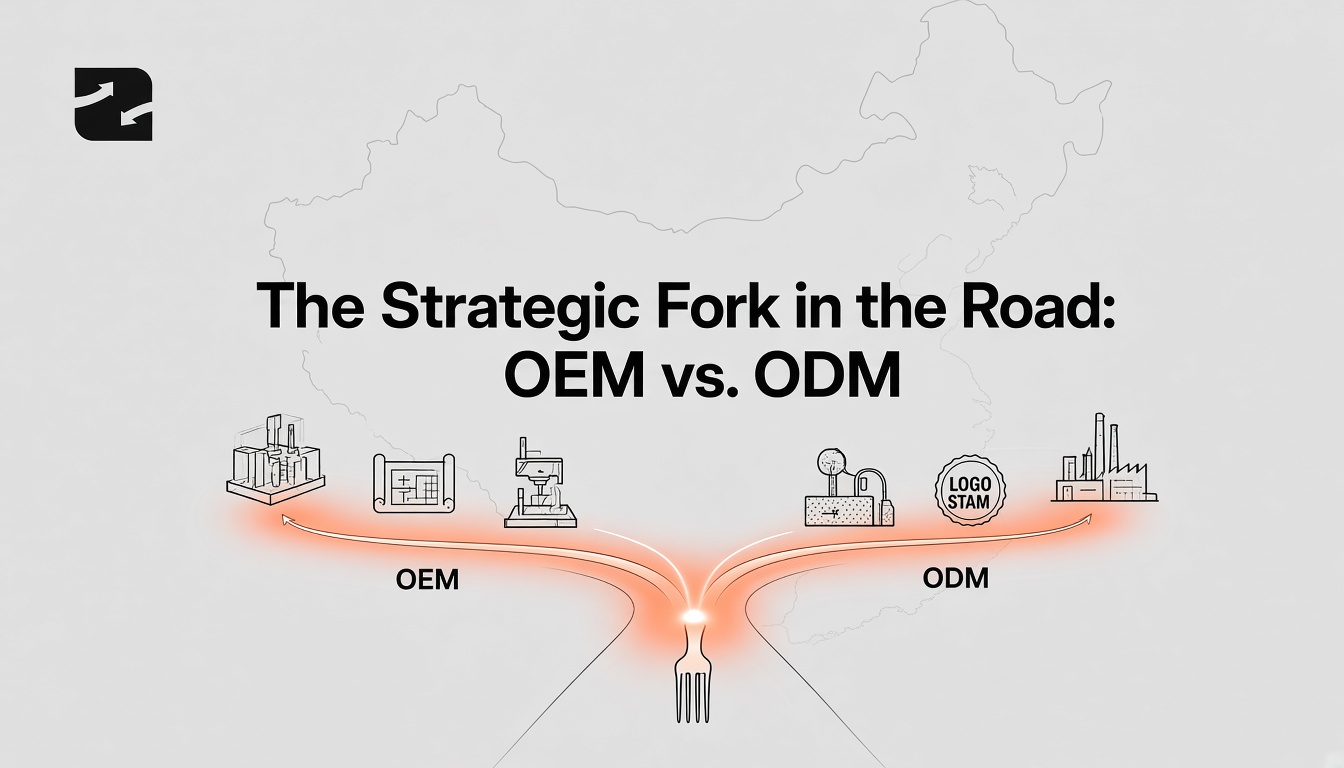
The Strategic Fork in the Road: OEM vs. ODM
When expanding your product catalog or launching a brand from scratch, your manufacturing strategy dictates everything: your initial capital expenditure, your speed-to-market, your unit margins, and how easily a competitor can copy your product.
Every day, importers ask us: "Should we buy an existing product and put our logo on it (ODM), or should we design our own product from the ground up (OEM)?"
The answer is rarely a simple matter of preference. It is a calculated trade-off between speed, control, unit economics, and intellectual property (IP) defensibility.
In this comprehensive guide, we unpack the mechanics of OEM and ODM manufacturing in China, reveal the hidden traps of off-the-shelf supplier tooling, break down the actual costs of injection molds, and provide the engineering roadmap you need to navigate custom production with certainty.
---
OEM vs. ODM: Clear Definitions
Before comparing costs and timelines, let us establish precise definitions:
ODM (Original Design Manufacturer) — "Private Label" or "White Label"
An ODM factory designs, engineers, and tools a product internally. The manufacturer owns the mechanical design, the electronics schematic, and the production tooling. As a buyer, you select an existing model from the factory's catalog, request minor aesthetic modifications (such as custom colors, silk-screened logos, or bespoke retail packaging), and sell it under your own brand name.
OEM (Original Equipment Manufacturer) — "Contract Manufacturing"
In an OEM arrangement, you bring your own proprietary design, 3D CAD files, Bill of Materials (BOM), and technical specifications to the factory. The factory acts strictly as your manufacturing facility, producing the goods according to your exact blueprints using custom tooling and molds funded and owned by you.
---
Head-to-Head Comparison: OEM vs. ODM
Dimension | ODM (Private Label) | OEM (Custom Manufacturing) |
|---|---|---|
Upfront Capital | Very Low ($500 – $5,000 for branding/packaging) | Moderate to High ($10,000 – $100,000+ for tooling & DFM) |
Development Time | 4 to 8 weeks to mass production | 4 to 9 months (prototyping, tooling, pilot runs) |
Tooling & Mold Ownership | Owned by the factory | Owned 100% by you (with proper contract) |
Gross Margin Potential | Moderate (35% – 55%) | High (60% – 85% at scale) |
Minimum Order Quantity (MOQ) | Lower (typically 500 – 1,000 units) | Higher (typically 2,000 – 5,000+ units) |
Competitive Moat | Low (competitors can buy the exact same unit) | High (proprietary design protected by patents & tooling) |
Engineering Burden | Minimal (factory handles technical aspects) | High (requires DFM, CAD review, and rigorous QC) |
---
The ODM Route: When and Why It Makes Sense
For early-stage e-commerce businesses, Amazon FBA sellers, or established brands testing a new product category, ODM offers unmatched advantages:
1. Lightning-Fast Speed to Market
Because the factory has already designed the product, resolved manufacturing defects, and built the injection molds or stamping dies, you bypass months of engineering. You can evaluate a pre-production sample in 7 days, finalize packaging artwork in 2 weeks, and enter mass production within 30 days.
2. Zero Tooling Capital at Risk
Building custom tooling for plastic injection molding, die-casting, or progressive stamping can cost between $15,000 and $80,000. With ODM, the factory absorbs that capital expenditure. If the product fails in your market, your financial exposure is limited to your initial inventory order.
3. Proven Manufacturability
New product development is notorious for unforeseen assembly bottlenecks and high initial defect rates. With an ODM product, the factory has already produced thousands of units. Their assembly workers understand the tolerances, solder points, and packaging requirements.
---
The Hidden Traps of ODM Sourcing
While ODM is fast and affordable, it carries structural risks that many first-time importers discover too late:
Trap 1: The "Supplier Tooling Monopoly"
Because the factory paid for the molds, they own the tooling. If the factory suddenly hikes your unit price by 25% on your third order, or if their lead times blow out from 30 days to 90 days, you cannot simply move the molds to another facility. Your product line is held hostage by that single supplier.
Trap 2: Design Cannibalization
Unless you negotiate an airtight exclusive distribution agreement (which factories rarely grant without massive annual volume commitments), the factory will sell the exact same product to your direct competitors. You might spend $50,000 on digital advertising to build customer awareness, only to see three rival brands pop up on Amazon or TikTok Shop selling the identical item for 20% less.
Trap 3: Component Downgrades Between Batches
Because you do not control the master Bill of Materials, unprincipled ODM factories frequently engage in silent component substitution. On order #1, they use a tier-one Samsung battery cell and copper wiring. On order #3, to claw back their margin, they quietly substitute a generic local battery cell and copper-clad aluminum wiring. Without on-site quality control, you only discover the change when customer return rates spike.
---
The OEM Route: When You Must Build Custom
If you are developing an innovative consumer hardware device, an ergonomic household item, or a specialized industrial component, OEM is the only route that builds lasting enterprise value.
1. Defensible Intellectual Property and Brand Moats
When you own the unique form factor, mechanical mechanism, and firmware, competitors cannot simply search Alibaba and undercut your pricing. Your product enjoys price elasticity because consumers cannot find an identical substitute.
2. Complete Quality Control Over the Bill of Materials
With OEM manufacturing, you specify every single sub-component: - Plastic resins (e.g., Sabic Cycolac ABS vs. generic recycled regrind) - Electronic components (e.g., Texas Instruments microcontrollers, Murata capacitors) - Fasteners and surface finishes (e.g., 304 stainless steel vs. zinc-plated mild steel; anodizing thickness)
The factory cannot alter a single supplier in the sub-tier supply chain without your written Engineering Change Order (ECO).
3. Maximum Unit Margins at Scale
While upfront tooling requires capital, the recurring cost of goods sold (COGS) in an OEM structure is substantially lower. You pay for raw materials, machine cycle time, assembly labor, and a transparent factory margin (typically 10% to 15%). You do not pay an inflated ODM royalty premium.
---
The 5 Phases of the OEM Product Development Roadmap
Navigating custom manufacturing in China requires a disciplined engineering stage-gate process. Skipping any of these steps inevitably leads to costly delays or catastrophic mass-production failures.
`
Stage 1: DFM & Tech Pack ➔ Stage 2: Rapid Prototyping ➔ Stage 3: Tooling Fabrication ➔ Stage 4: EVT / DVT / PVT Validation ➔ Stage 5: Mass Production & PSI
`
Stage 1: Design for Manufacturing (DFM) Review
Before sending CAD models to a factory, your designs must undergo a DFM analysis. Chinese toolmakers will evaluate draft angles (typically 1° to 2° for mold release), wall thickness consistency (to prevent sink marks and warping), gate locations, and parting lines. A thorough DFM review catches tooling flaws on a computer screen before you cut steel.
Stage 2: Rapid Prototyping
Never cut an injection mold based solely on a 3D digital model. Produce physical prototypes using: - SLA / SLS 3D Printing: For aesthetic verification and ergonomic hand-feel. - CNC Machining: In production-grade plastics (ABS, POM, PC) or metals (Aluminum 6061) to test mechanical fit and structural strength. - Vacuum Casting (Silicone Molds): To produce 10 to 30 functional units for drop testing, regulatory certifications, and initial consumer feedback.
Stage 3: Tooling and Mold Fabrication
Once prototypes pass testing, mold building begins. The toolmaker creates the core, cavity, slide mechanisms, cooling channels, and ejector pin layout. - T0 Samples: The very first trial shots directly from the mold. These are rough, untextured parts used to inspect dimensions and plastic flow. - T1 Samples: Adjusted samples after mold polishing and dimensional tuning. Used for tolerance verification and assembly testing. - T2 / Golden Sample: The finalized, fully textured, production-ready unit approved as the contractual benchmark.
Stage 4: EVT, DVT, and PVT Production Validation
For complex consumer goods and electronics, never jump straight into full-scale mass production: 1. EVT (Engineering Validation Test): 20–50 units built on the actual line to verify that the design functions as intended. 2. DVT (Design Validation Test): 50–200 units subjected to stress testing, thermal cycling, drop tests, and compliance testing (CE, FCC, RoHS, UL). 3. PVT (Production Validation Test): A pilot run of 200–500 units run at full production line speed to verify worker assembly cycle times and quality repeatability.
Stage 5: Mass Production and Pre-Shipment Inspection (PSI)
Only after PVT units pass an AQL Level II inspection do you issue the formal authorization for mass manufacturing.
---
Demystifying Injection Mold Tooling Costs in China
Tooling quotes can vary wildly between suppliers. One factory might quote $8,000 while another quotes $22,000 for the exact same plastic enclosure. Why?
Tooling Steel Grades and Shot Lifespan
Steel Grade | Hardness (HRC) | Typical Mold Lifespan (Shots) | Best Used For |
|---|---|---|---|
P20 | 28–32 | 100,000 to 200,000 | Low to mid-volume consumer goods, initial trial runs |
718H | 33–38 | 300,000 to 500,000 | Mid-to-high volume, high-polish cosmetic surfaces |
NAK80 | 37–43 | 500,000+ | Optical lenses, mirror finishes, transparent PC/PMMA |
S136 (Stainless) | 48–54 | 1,000,000+ | Corrosive plastics (PVC), medical-grade parts, high-volume production |
A low quote often means the supplier intends to use cheap, unhardened domestic steel that will wear out after 30,000 cycles, causing flash, dimensional drift, and surface defects.
Crucial Clauses in Your Tooling Agreement
If you fund the tooling, ensure your contract explicitly states: 1. 100% Buyer Ownership: You hold undisputed legal ownership of the mold core, cavity, and base. 2. Dedicated Use: The factory is prohibited from running parts from your mold for any other customer. 3. Physical Custody and Transfer Rights: You retain the unconditional right to inspect, audit, and physically remove the mold from the factory within 48 hours. 4. Tooling Maintenance Obligation: The factory is responsible for routine cleaning, lubrication, and replacement of consumable parts (ejector pins, O-rings) throughout the contractual shot life.
---
How ZhuohuanGroup Protects Your OEM/ODM Journey
Navigating custom contract manufacturing across language barriers and time zones requires experienced boots on the ground:
- Factory Qualification: We audit factories in Shenzhen, Dongguan, Ningbo, and Wenzhou to verify whether a supplier is a genuine OEM manufacturer or a trading company sub-contracting your project. - On-Site DFM & Mold Custody: Our bilingual engineers review tooling blueprints, witness T1 mold trials in person, and physically tag your tooling with custom metal serial plates. - Airtight Contracts: We draft bilingual NNN agreements and Contract Manufacturing Agreements (CMAs) enforceable under Chinese law. - Milestone-Based Payments: We structure payments so you only release tooling balances after physical T1 samples pass laboratory inspection.
Whether you need to private-label an existing catalog product or build a complex OEM assembly from CAD blueprints, having on-the-ground management turns sourcing uncertainty into a predictable competitive advantage.
Ready to evaluate your product blueprints or review a factory quotation? [Contact ZhuohuanGroup for an engineering consultation](/quote) — our team responds within 24 hours.